Reviewed · TOURS
San Francisco Four Peaks Tour
San Francisco’s Four Peaks Tour turns Eureka Valley into an outdoor history book. Over three to four hours, you walk from the Castro through old Irish parish streets, gay-community landmarks, steep residential hills, secret staircases, and four excellent viewpoints.
I like the small maximum of eight people, which gives the guide room to tell stories and adjust the pace. I also like the mix of history and odd local details, including hidden concrete slides, secluded gardens, and a podium missing its statue.
The catch is simple: this is a real hill walk, not a gentle neighborhood stroll. You need moderate fitness, good walking or hiking shoes, and enough energy for repeated climbs. Weather can also cancel the tour, so keep some flexibility in your schedule.
In This Review
- Four things to know before you book
- Starting where Market Street once stopped
- The Castro and four surrounding hills
- Tank Hill and the big city view
- Corona Heights, cut from a much larger hill
- Dolores Heights, Twin Peaks, and the route between them
- Secret stairs, concrete slides, and the missing statue
- The history of a changing community
- How hard is the walking?
- Hot Cookie and the extra-cost treat
- Is $65 a fair price?
- Weather, cancellation, and planning the day
- Who should book the Four Peaks Tour?
- Final verdict: a strong choice for curious walkers
- FAQ
- Where does the San Francisco Four Peaks Tour begin?
- Where does the tour end?
- How long does the tour last?
- How much does the tour cost?
- What areas does the tour visit?
- Is the tour physically demanding?
- How many people can join the tour?
- Is food included?
- Is public transportation available near the meeting point?
- What happens if bad weather cancels the tour?
Four things to know before you book
- Eureka Valley’s story comes in layers: You’ll hear about farmland on the city’s edge, Irish churches from the 1890s, streets abandoned in the 1960s, and the gay community that brought new life in the 1970s.
- The views are the main reward: Tank Hill and the other high points give you a fresh way to see San Francisco, especially if you have already visited the usual lookout spots.
- The route includes real uphill walking: Expect steep streets and uneven sections. Hiking shoes are a wise choice.
- The group stays small: The tour accepts no more than eight people, making it easier to hear the guide and ask questions.
- Ryan has led highly praised departures: His energetic, friendly style and strong local knowledge have made a clear impression on people who took the walk with him.
- The snack stop is optional: Hot Cookie is included as a stop, but the treat costs extra.
Starting where Market Street once stopped
Meet at Castro Street and Market Street, a useful starting point for understanding Eureka Valley. This area was once treated as the outskirts of San Francisco, where Market Street gave out and cows grazed beyond the settled part of the city.
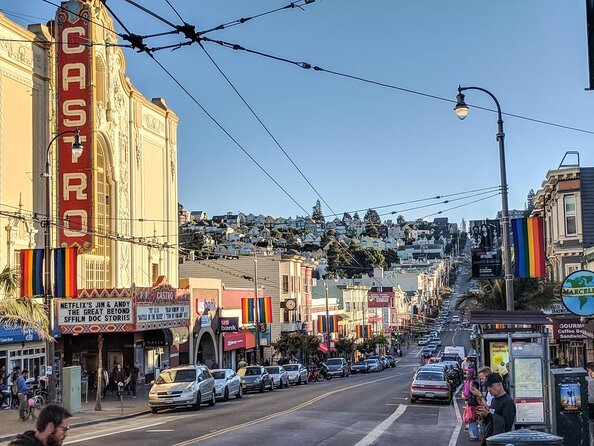
That old image helps frame the walk. Today, the Castro is one of San Francisco’s best-known districts, but the tour asks you to look past the familiar rainbow flags and busy storefronts. You’ll trace the older shape of the valley and the hills around it.
The route covers parts of the Castro, Twin Peaks, Corona Heights, and Dolores Heights. These are not separate attractions connected by a bus. You move between them on foot, so the city itself becomes the exhibit.
I like this approach because Eureka Valley is easy to rush through. You might recognize the Castro as a major cultural center, then miss the streets and slopes that explain how the district grew. A guide can connect the physical setting to the social changes that shaped it.
The tour also makes room for small discoveries. You may see relics linked to the 1850s outskirts, older religious buildings tied to the Irish community of the 1890s, and public spaces that would be easy to overlook without local direction.
A few more San Francisco tours worth comparing
- Muir Woods and Sausalito (Return by Bus or Ferry)
★ 4.5 · 5,098 reviews - Big Bus SF: Hop-on Hop-off Tour with 17 Stops and Sunset Option
★ 4.0 · 4,539 reviews - Napa and Sonoma Wine Country Full-Day Tour from San Francisco
★ 4.5 · 4,455 reviews
The Castro and four surrounding hills
The first major section centers on the Castro and the four hills around Eureka Valley. The tour treats these hills as more than lookout points. Their slopes explain why the neighborhood feels so different from the flatter parts of San Francisco.
You’ll hear how streets and buildings changed over time. Eureka Valley went from a fringe area to a settled neighborhood, then through a period when some streets were left behind in the 1960s. In the 1970s, the growing gay community helped bring new energy and purpose to the area.
That history matters because it gives the walk a human scale. You are not only looking at old buildings or taking photographs. You are seeing how communities claim space, adapt it, and give it a new meaning.
The Castro portion is listed as about one hour. That makes it the longest named stop, and rightly so. There is a lot to cover before the route moves higher into the hills.
Do not expect a museum-style presentation. This is an active walk, with stories delivered along streets, paths, and viewpoints. If you prefer a tour with long periods inside buildings, this is not the right fit. If you enjoy learning while moving through a neighborhood, the format works well.
Tank Hill and the big city view
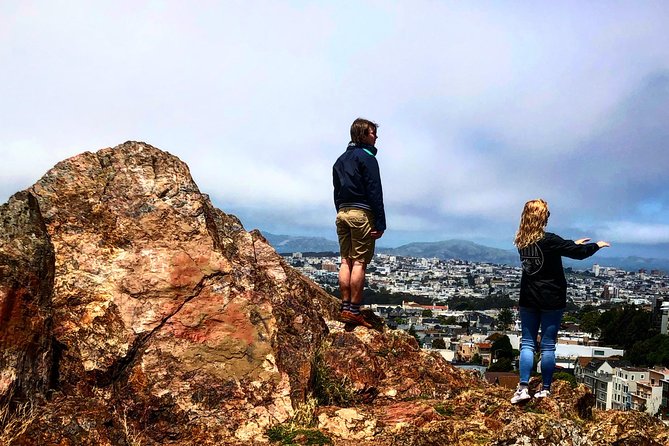
Tank Hill receives about 40 minutes and is presented as one of the best viewpoints on the route. The name may sound industrial, but the payoff is visual: you climb for a broad look across San Francisco.
This is where the physical effort starts to make sense. A city view from a famous roadside lookout can be quick and crowded. A hill reached on foot feels different. You have worked your way above the streets, and the changing height gives you a clearer sense of San Francisco’s steep geography.
I would plan to pause here rather than treat the viewpoint as a quick photo stop. The walk is designed around four high points, and Tank Hill is one of the places where you can appreciate the larger pattern.
The tour’s small size helps at stops like this. With no more than eight people, you should have a better chance of hearing the guide’s explanation and finding a comfortable place to stand. The experience is still outdoors, though, so conditions can affect how long you want to linger.
The best views depend on weather. On a clear day, the hilltop portion can be the highlight of the outing. On a gray or windy day, the historical stories and unusual neighborhood details carry more of the experience.
Corona Heights, cut from a much larger hill
The route then reaches Corona Heights, another stop of about 40 minutes. This neighborhood sits between Buena Vista Park and Eureka Valley, and its shape tells an important story about how San Francisco was built.
The streets here were cut out of a large hill that once covered all of Buena Vista Park and extended toward Market Street. That fact gives Corona Heights a strong sense of physical change. The streets are not simply laid across an untouched setting. They were carved into the hill as the city expanded.
You’ll want to pay attention to the relationship between road, slope, and buildings. The point is not just to reach another summit. It is to understand how the city reshaped the ground beneath it.
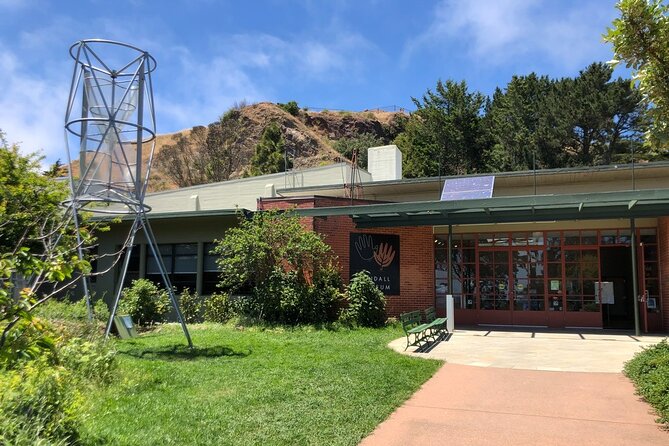
Corona Heights also provides the tour’s finale near the Randall Museum. The museum is described as a fascinating stopping point at the peak, adding a cultural destination to the final view.
There is one practical detail worth checking before you set out. The tour information describes the route as ending at the Randall Museum, while the meeting details say the activity ends back at the Castro meeting point. That may reflect a return walk or a difference in how the end point is recorded. Ask for the exact finish location when you book, especially if you have dinner plans or a separate reservation.
A different sort of day in San Francisco altogether:
- Small Group Yosemite and Giant Sequoias Day Trip from San Francisco
★ 5.0 · 3,671 reviews - Yosemite Highlights & Giant Sequoias Day Tour from San Francisco
★ 4.5 · 3,455 reviews - San Francisco Super Saver: Muir Woods & Wine Country w/ optional Gourmet Lunch
★ 4.5 · 3,352 reviews - San Francisco: Golden Gate Bay Cruise (1-hour)
★ 4.7 · 3,071 reviews
Dolores Heights, Twin Peaks, and the route between them
The experience also takes in Dolores Heights and Twin Peaks as part of its four-peak route. The named stop schedule gives separate detail for the Castro, Tank Hill, and Corona Heights, while the wider tour description identifies four major areas: the Castro, Twin Peaks, Corona Heights, and Dolores Heights.
That means you should view the tour as a connected hill walk rather than a list of fully separate attraction visits. The exact order and time spent at each high point can vary, particularly because the tour depends on weather and the group’s pace.
Twin Peaks is one of San Francisco’s most recognizable high areas, while Dolores Heights offers another angle on the city’s residential hills. The value here is comparison. Each rise gives you a different relationship to the surrounding streets, and the walk shows how close these districts are despite their sharp changes in elevation.
I would not book this expecting four long, formal sightseeing stops with plenty of free time at each one. The three-to-four-hour schedule has to include walking between points. You are paying for the route, the interpretation, and the access to lesser-seen corners, not simply for time at a viewpoint.
Secret stairs, concrete slides, and the missing statue
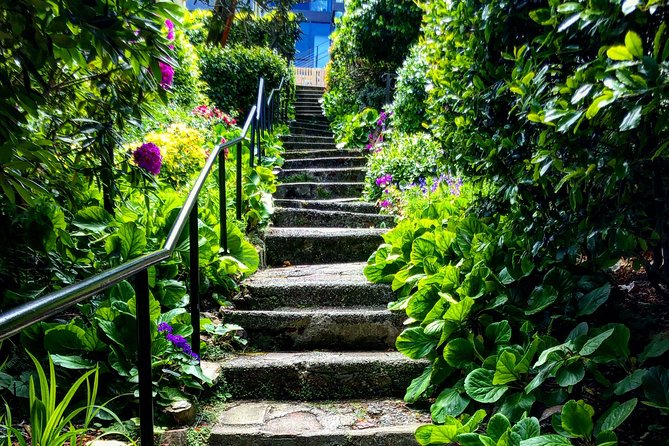
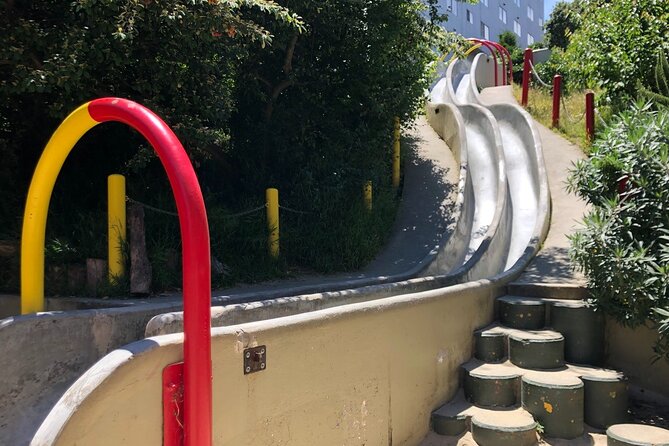
The tour’s most memorable details may be the ones that are not marked in a guidebook. Expect secret staircases, hidden concrete slides, secluded gardens, and a podium where the statue is missing.
These odd features add character to the walk. They also reward you for going with someone who knows the neighborhood well. You could find a few of these on your own with enough time and searching, but most visitors are unlikely to build them into a coherent route.
The concrete slides are especially useful for understanding the tour’s tone. This is not only a serious history lesson. It also pays attention to the strange, playful, and slightly unfinished parts of the city.
The missing statue offers a different kind of local story. A vacant podium can say as much about public memory as a monument can, especially when a guide explains what once occupied the space and why it matters.
These small discoveries are where the tour earns its personality. They prevent the walk from becoming a standard hill climb with a series of scenic pauses.
The history of a changing community
The strongest part of the tour is the way it links place and social change. Eureka Valley’s story moves from farmland and city outskirts to an Irish immigrant community, then to decline in parts of the area during the 1960s, followed by renewal through the gay community in the 1970s.
You will not get the full history of San Francisco in one morning or afternoon. What you can get is a focused story about one neighborhood and how its identity changed.
That focus is useful for first-time visitors who want more than postcard views. It is also worthwhile if you have already seen the main sights. One person who had visited San Francisco many times described the walk as giving a fresh experience of the city, which makes sense: the route changes your view both literally and historically.
The tour also avoids treating the Castro as a single story. The district is part of a broader valley, surrounded by hills, churches, homes, gardens, and paths. You get a better sense of how culture, topography, and urban growth overlap.
Guide Ryan has been singled out for his enthusiasm, friendliness, and local storytelling. Those traits matter on a walking tour. A dull presentation can make a steep climb feel longer. An engaged guide can make the same climb feel purposeful.
How hard is the walking?
The operator recommends a moderate level of physical fitness, and you should take that seriously. The route crosses several San Francisco hills, so the challenge comes from repeated climbs rather than one short burst of effort.
Wear hiking shoes or sturdy walking shoes. The instruction to wear hiking shoes is not decorative advice. You may encounter steep streets, stairs, and uneven walking surfaces as you move between the hills.
I would bring water and dress for changing conditions, though the supplied details do not specify what refreshments are provided. The tour lasts roughly three to four hours, so you should be comfortable being outdoors for that length of time.
The route may suit you if you enjoy walking tours, viewpoints, and neighborhood history. It may not suit you if steep streets cause pain, if you need frequent indoor breaks, or if you want a slow, flat city walk.
Service animals are allowed, and the meeting point is near public transportation. The group limit of eight is another advantage for anyone who wants a more personal pace, though it does not remove the physical demands.
Hot Cookie and the extra-cost treat
A snack stop is made at Hot Cookie, a famous local favorite. The food is not included in the $65 price, so you should carry a little extra money if you want to buy something.
I like this kind of stop because it gives the group a small break and connects the tour to a real neighborhood business. It is not a catered snack added to the ticket. You choose whether to purchase something.
The stop also gives you a chance to judge your own energy. If you are hungry before the walk, eat beforehand. The available information only promises a stop where snacks can be purchased, not a full meal or a guaranteed amount of time to eat.
Is $65 a fair price?
At $65, the tour is not the cheapest way to see San Francisco’s hills. You can walk through the Castro and visit public viewpoints on your own without paying admission. The hills, streets, gardens, and views themselves are free.
The question is what you want to buy. You are paying for a planned route, local storytelling, access to less obvious features, and the convenience of connecting four high points without doing the research yourself.
The value improves if you are short on time or have already seen San Francisco’s standard sights. A good guide can help you notice details you would pass by, and the small group makes the experience more conversational than a large sightseeing walk.
The value is weaker if you mainly want a single viewpoint or prefer to explore independently. You can get broad city views for less money, but you will not necessarily get the same sequence of historical context and neighborhood oddities.
Customizations are available, which may add value if your group has particular interests. The details of those customizations are not specified, so ask what can be changed before booking.
Weather, cancellation, and planning the day
The tour requires good weather. If poor conditions cancel it, you are offered another date or a full refund.
For your own planning, free cancellation is available until 24 hours before the start time. Cancel at least 24 hours ahead for a full refund. Cancellations or changes made within 24 hours are not accepted for a refund.
Confirmation is sent within 48 hours of booking, subject to availability. Since one past booking was canceled by the operator the evening before because of a childcare problem, I would avoid placing an important, nonrefundable dinner or transport connection immediately after the tour. That cancellation appears to have been an isolated problem, but it is still a sensible planning lesson.
The tour ends at the stated meeting point according to the meeting details, while the route description places the finale at the Randall Museum. Confirm the finish location and expected end time so you know how to arrange the rest of your day.
Who should book the Four Peaks Tour?
I would recommend this walk to you if you want San Francisco history tied to real streets and hills. It is especially good for repeat visitors, curious walkers, and anyone who likes unusual public spaces more than polished attractions.
You should also book it if views are high on your list. The four-peak format gives you several chances to see the city from different heights, with Tank Hill called out for its especially strong outlook.
Families with older children might enjoy the slides and odd local details, but the fitness requirement still matters. The route is not presented as a child-focused activity, and younger children may find the duration and climbs tiring.
You may want another tour if you need a flat route, indoor shelter, or a tightly guaranteed schedule. You should also think twice if you dislike weather-dependent plans or would rather spend three hours inside museums and landmark buildings.
Final verdict: a strong choice for curious walkers
Book the Four Peaks Tour if you want a small-group hill walk that combines city views with the less polished, more revealing side of San Francisco. The best parts are the local stories, the changing views, and the small discoveries that are easy to miss alone.
At $65, the tour is worth it when interpretation and route planning matter to you. It is less compelling if you only want free viewpoints or a gentle neighborhood stroll.
Wear proper shoes, allow three to four hours, keep a snack budget for Hot Cookie, and confirm the final meeting point. If you can handle the climbs, this is a lively way to understand how Eureka Valley changed from the city’s edge into one of San Francisco’s most important cultural districts.
FAQ
Where does the San Francisco Four Peaks Tour begin?
It begins at Castro Street and Market Street in San Francisco, California.
Where does the tour end?
The meeting information says the activity ends back at the starting point. The route description also refers to a conclusion at the Randall Museum, so you should confirm the exact finishing point when booking.
How long does the tour last?
The experience lasts approximately three to four hours.
How much does the tour cost?
The listed price is $65.
What areas does the tour visit?
The tour covers Eureka Valley, including the Castro District, Twin Peaks, Corona Heights, and Dolores Heights.
Is the tour physically demanding?
The tour requires a moderate level of physical fitness and includes several San Francisco hills. Hiking shoes are recommended.
How many people can join the tour?
The maximum group size is eight travelers.
Is food included?
No. A snack stop is made at Hot Cookie, but snacks are available for purchase and are not included in the tour price.
Is public transportation available near the meeting point?
Yes. The meeting point is near public transportation.
What happens if bad weather cancels the tour?
You will be offered a different date or a full refund if the experience is canceled because of poor weather.
Recently added around San Francisco
- Guided Private Wine Tour to Napa and Sonoma Wine Country★ 5.0 · 3 reviews
- San Francisco: Muir Woods Giant Redwoods & City Private Tour★ 5.0 · 3 reviews
- Napa or Sonoma Private Wine Tour from San Francisco★ 5.0 · 3 reviews
- San Francisco Chinatown Food and Culture Tour★ 5.0 · 3 reviews
- San Francisco City Half-Day Private Custom Tour★ 5.0 · 3 reviews
- SFO Pick-Up with City Sightseeing Tour★ 5.0 · 3 reviews
- 6-Hour Luxury Napa Wine Tasting Tour with Route Planning★ 5.0 · 3 reviews
- Muir Woods, Sausalito and Ferry back to Fisherman’s Wharf★ 4.7 · 3 reviews
Tours, compared.
Big Bus SF: Hop-on Hop-off Tour with 17 Stops and Sunset Option
Read our review →
Napa and Sonoma Wine Country Full-Day Tour from San Francisco
Read our review →
Yosemite Highlights & Giant Sequoias Day Tour from San Francisco
Read our review →
Combo Tour: Alcatraz Island and San Francisco Grand City Tour
Read our review →
Monterey, Carmel and 17-Mile Drive: Full Day Tour from SF
Read our review →